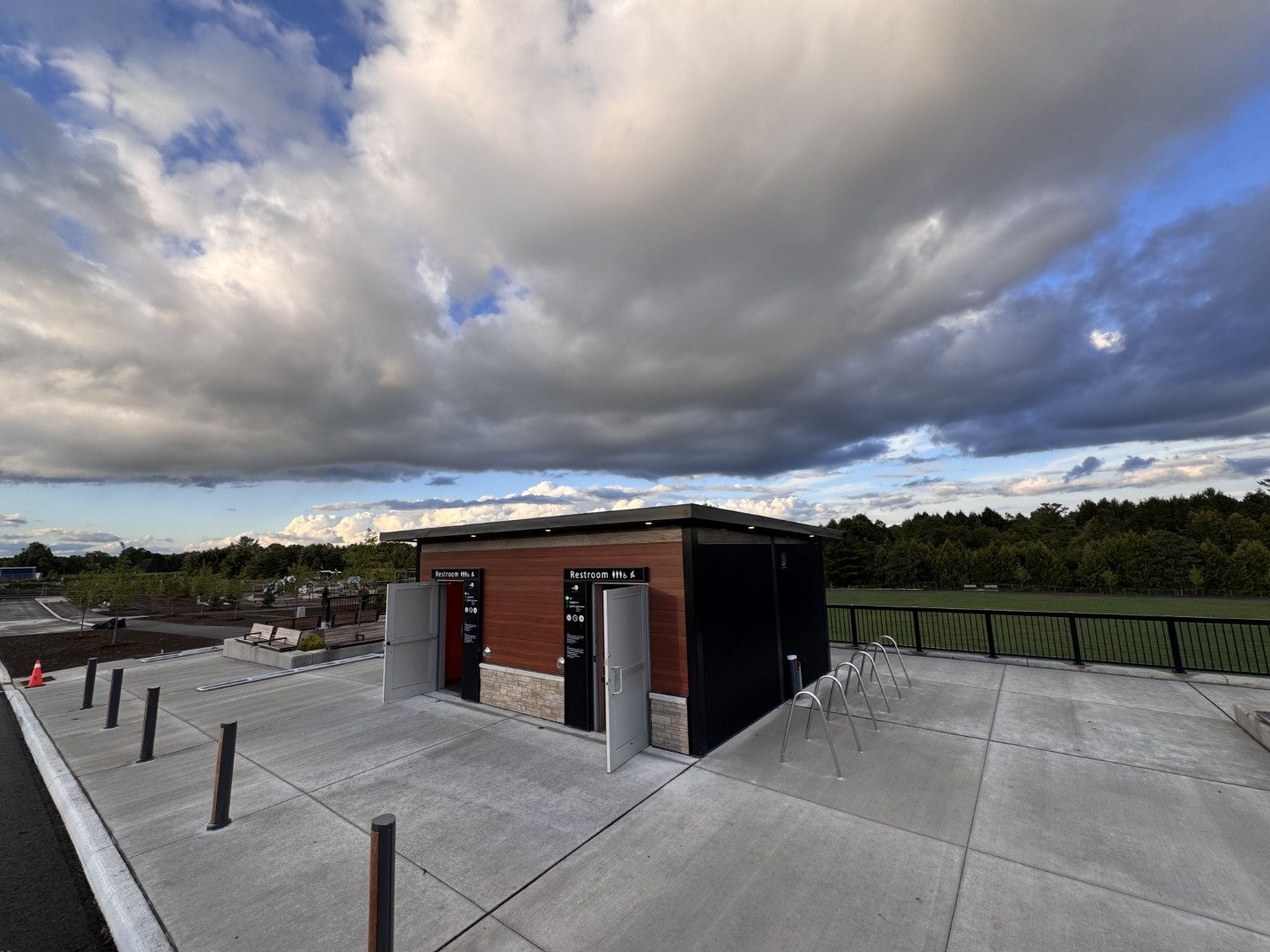
Standard Public Restroom vs. Urben Blu Smart Restroom: Two Completely Different Realities
Introduction
In procurement documents and committee discussions, the same term is often used: “public restroom.”
Yet behind those words lie two fundamentally different realities.
On one side: the standard public restroom, often based on outdated practices.
On the other: the Urben Blu smart restroom, designed to address today’s municipal challenges—labour shortages, security concerns, increased park usage, rising citizen expectations, accessibility standards, and operational efficiency.
Below is a concrete comparison of these two approaches.
1. Cleaning: Manual and variable… or intelligent and consistent
In a standard restroom, cleanliness depends entirely on staff availability.
When teams can visit frequently, the restroom stays clean.
When time is limited—as is increasingly the case—the citizen experience deteriorates quickly.
With Urben Blu, cleanliness is no longer conditional—it is automatic.
After each use, the unit performs:
- full bowl washing and disinfection
- programmable floor-washing cycles
- rapid drying before reopening
- automatic locking during cleaning to prevent accidental entry
Result:
Cleanliness no longer depends on staffing levels—it becomes consistent, predictable, and measurable.
2. Access to components: Exposed… or separated and secured
In standard restrooms, mechanical systems are often accessible from the user area:
exposed plumbing, reachable tanks, fragile surfaces.
A single act of vandalism can shut down the facility for days.
Urben Blu completely reverses this model.
A separate, secured technical room houses:
- plumbing
- ventilation
- electrical panels
- consumables
- electronic systems
Maintenance teams can intervene without entering the user cabin, which:
- reduces risk
- speeds up repairs
- protects mechanical systems
- minimizes service interruptions
This approach is purpose-built for municipal realities: efficient, fast, and safe.
3. Durability: Lightweight structure… or steel-and-concrete infrastructure
Many traditional restrooms use materials designed for indoor use: thin panels, lightweight partitions, structures poorly suited to vandalism or harsh climates.
Urben Blu is built as permanent municipal infrastructure, featuring:
- galvanized steel frame
- ultra-high-performance fiber-reinforced concrete (UHP) walls and floors
- anti-graffiti protection
- certified resistance from –40°C to +40°C
This is a building designed to last decades—not seasons.
4. Management and data: Blind… or connected and proactive
A standard restroom provides no operational data. Municipal teams do not know:
- how many users visited
- when cleaning is truly needed
- if temperatures drop below freezing
- if an occupant stays too long
- if consumables are running low
Urben Blu communicates.
Its web platform provides real-time monitoring:
- usage counts
- email alerts (temperature, consumables, anomalies)
- programmable operating schedules
- prolonged presence detection
- simplified technical diagnostics
This is a restroom that actively supports municipal teams and saves time.
5. Function: Minimal cabin… or scalable sanitary infrastructure
A standard restroom fulfills a narrow, fixed need.
It is not designed to adapt.
Urben Blu, by contrast, is conceived as a modular urban asset, offering:
- full universal accessibility
- exterior digital signage options
- optional add-on modules (shelters, storage, lockers, fountains, etc.)
- relocatability if site needs change
- seamless integration into parks, transit hubs, downtowns, bike paths, and more
It is an evolving solution, built to grow with communities.
Conclusion: Two philosophies, two outcomes
Comparing a standard restroom to an Urben Blu smart restroom is like comparing a prefab shelter to a modern municipal building.
Both may serve a function—but not with the same performance, durability, or operational control.
Urben Blu stands on three essential pillars:
- Performance (self-cleaning, robustness, reliability)
- Control (data, alerts, remote management)
- Durability (materials, structure, longevity)
For municipalities, this means:
- less stress
- fewer surprises
- lower operating costs
- and above all, a better citizen experience