Debunking common myths about self-cleaning public restrooms: why Urben Blu changes the game
Introduction
For a long time, the term self-cleaning restroom has generated as much skepticism as interest.
Some recall older European models that were imported too quickly and poorly adapted to North American realities. Others still associate these installations with systems perceived as complex, fragile, or difficult to maintain.
The result?
Many municipalities hesitate—not because the need is not real, but because outdated assumptions no longer reflect today’s reality.
Urben Blu was created specifically to address these concerns by redefining what a modern public restroom should be: robust, simple, durable, and designed for our climate. Let’s break down the four most common misconceptions—and explain why they no longer hold up.
Misconception 1: “It’s too fragile for our climate.”
This belief largely stems from older models designed for mild climates.
Québec is not Paris. Michigan is not Barcelona.
Urben Blu, on the other hand, was developed here, for here.
In practical terms, this means:
- 100% Québec-based manufacturing in Boisbriand
- An insulated steel structure with R-24.5 walls and an R-40 roof
- A PVC membrane roof designed to withstand freeze–thaw cycles
- Redundant heating systems (radiant floor, forced air, and high-performance HRV)
- Engineering validated for operation from –40°C to +40°C
These are not theoretical numbers—they reflect the real conditions of our winters, cold snaps, thaws, and humid summers.
Urben Blu was designed to withstand them without compromise.
Misconception 2: “If something breaks, it’s impossible to repair.”
This may be true for some imported systems with proprietary parts that are inaccessible or integrated directly into the user area.
Urben Blu took the opposite approach: simplifying maintenance as much as possible.
The system includes:
- A separate technical room with independent access, isolated from the user area
- Standard components commonly used in municipal buildings (plumbing, electrical, heating, HRV)
- Direct access to consumables and controls
- No user-accessible moving mechanical parts
Result?
Any municipal technician can intervene—quickly and efficiently.
There is no need to wait for a specialist from overseas or the manufacturer. Everything is logical, accessible, and easy to service.
Misconception 3: “It’s complicated for citizens.”
This perception often comes from models that relied on multiple buttons, menus, indicator lights, and sometimes even conflicting instructions.
Urben Blu takes a different approach: an intuitive, user-centered experience.
From a citizen’s perspective:
- They enter (automatic door)
- The restroom detects their presence
- They use the facilities without touching any buttons
- They exit
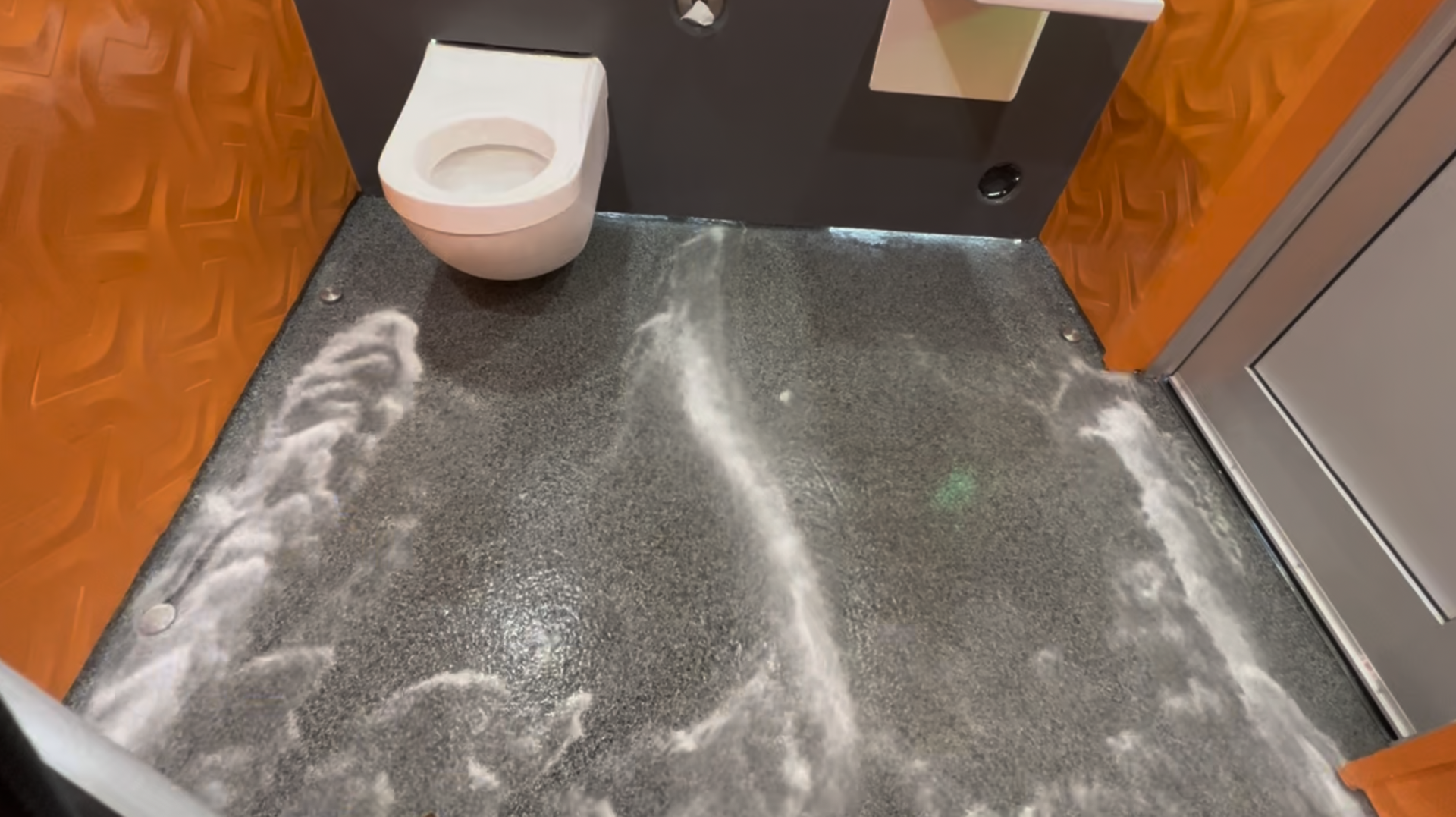
- The cleaning cycle starts automatically
Everything is touch-free:
- Automatic flushing
- 3-in-1 sink (water, soap, hand drying)
- Motion-activated lighting
- Automated locking
Clear exterior signage—available, occupied, cleaning, out of service—removes any uncertainty.
In short, it’s a public restroom—but simpler.
And much cleaner.
Misconception 4: “It consumes excessive water and energy.”
This is another legacy assumption tied to older designs.
Urben Blu was optimized to minimize resource consumption at every level.
Its performance includes:
- Low water usage (flushing, floor washing, handwashing)
- LED lighting activated only during use
- ENERGY STAR® HRV with heat recovery
- Cleaning cycles adjustable based on actual usage
- Very low electrical consumption per cycle
The objective is clear: outperform traditional installations while reducing operating costs.
Conclusion: a new generation of self-cleaning public restrooms
If self-cleaning restrooms once had a poor reputation, it was because they were not designed for the North American context.
Urben Blu represents the next generation:
- The robustness required for municipal environments
- The maintenance simplicity of a standard building
- The performance of reliable, proven technology
- A design engineered for winter conditions, durability, and citizen experience
These are not “self-cleaning restrooms of the past.”
They are restrooms designed for today—and for the next 20 years.